The Real Cost of Misunderstanding Walkability in Miami Real Estate
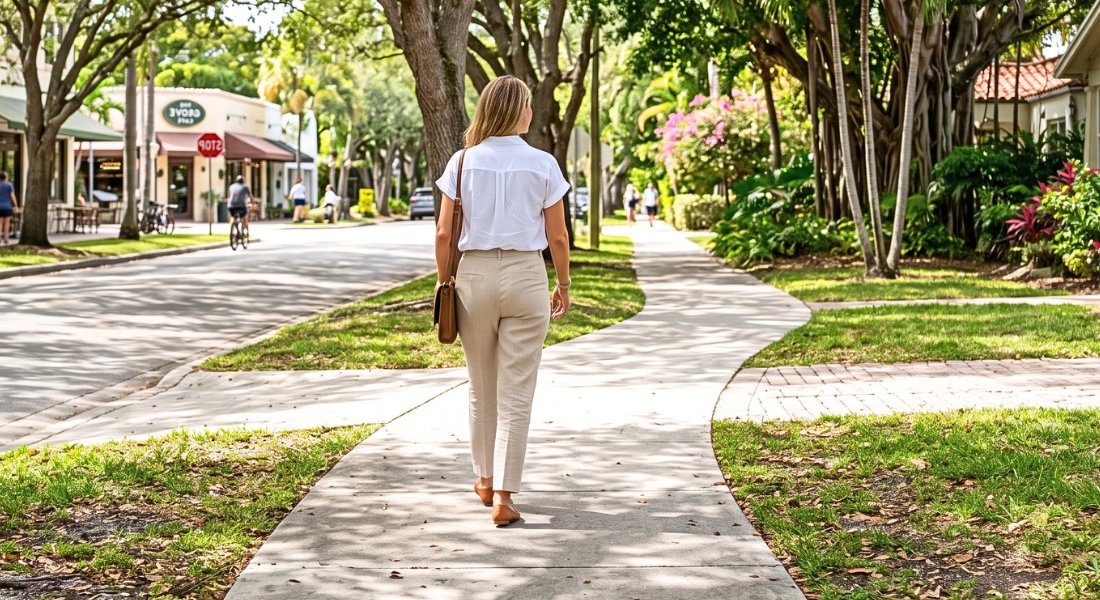
Walkability has shifted from a lifestyle preference to a genuine valuation driver in Miami real estate. Buyers now use it to filter neighborhoods before considering square footage, lot size, or even price. The problem is that many buyers and even some agents measure Miami walkability incorrectly. A flawed definition can send a home search toward significantly different price points.
For Miami buyers, a practical way to assess walkability is to look within a one-mile radius for a genuine amenity base. Relatively few Miami neighborhoods offer that combination. That distinction can separate communities competing for the same buyers from those that do not. Knowing which is which before starting a search can give buyers a practical advantage.
Defining Walkability in a City Built Around Cars
The one-mile radius is a practical benchmark for evaluating Miami walkability. At roughly a 15- to 20-minute walk, it captures everyday destinations that make proximity a meaningful lifestyle benefit. Properties within that radius can command higher values than comparable homes just outside it, even when they look nearly identical on paper.
Miami’s walkability differs from Manhattan’s. Here, it can mean the difference between walking to dinner, running errands, or grabbing coffee and needing a car for those activities. For buyers from denser cities, understanding that distinction early can prevent searches through neighborhoods that do not fit their lifestyle.
The right question is not simply, “Can I walk somewhere from this house?” It is, “Can I walk to the places that will make my daily life meaningfully better?”
The Miami Neighborhoods Where It Works
Coconut Grove is among Miami’s most walkable communities and remains highly competitive. Both North Grove and South Grove offer single-family homes within that one-mile range. North Grove also has a substantial townhouse corridor a short walk to the village center. Buyers arriving from New York, Chicago and California often seek out the Grove because it combines urban energy with a walkable, neighborhood-scaled environment. That combination is rare in Miami.
Coral Gables is larger and more varied, so walkability is not uniform throughout the city. Areas around Miracle Mile, Giraldo Plaza, Ponce de Leon and the Alhambra corridor put residents within walking distance of restaurants, shops, and Miami’s active international business district. Merrick Park is also a hot neighborhood for accessibility to luxury shopping and dining. The challenge is identifying which streets fall within that radius and which ones only feel close. A home two miles from Miracle Mile may be close by Miami standards, but it falls outside the one-mile benchmark. For a broader look at how Coconut Grove and Coral Gables differ beyond walkability, see this Coconut Grove and Coral Gables guide.
South Miami is another community worth considering and remains a strong contender for walkability. Smaller lots, a village-scaled city center, and close access to retail and dining make it a legitimate contender. Located between Coral Gables and Pinecrest, South Miami can appeal to buyers who have considered both neighborhoods. It offers a walkable setting at a lower entry point than some nearby alternatives.
Why Pinecrest Fails the Walkability Test
Pinecrest is a superb community, but it does not offer the kind of walkability many buyers associate with a neighborhood center. Excellent schools, large lots, and quiet residential streets make it highly attractive to residential buyers. What it lacks is a strong amenity base within a mile of most homes. Some properties along the US-1 corridor sit close to commercial activity, but the overall amenity base remains limited.
Buyers who prioritize walkability may find Pinecrest beautiful but less suited to the lifestyle they want. It is important to distinguish it from communities that offer a true neighborhood center. Treating Pinecrest and Coconut Grove as interchangeable can send luxury buyers toward a neighborhood that does not fit their priorities.
The Price of a Walkable Address
Properties inside a walkable radius can command a price premium that is not always obvious from the listing description. An agent may describe a home as walkable even when the nearest meaningful amenities are two miles away. Buyers who rely on that description can waste valuable time evaluating a property that cannot deliver the lifestyle they expected.
This pattern comes up regularly in buyer consultations, and the answer often surprises people. Research has examined the relationship between walkability and residential property values, supporting the broader connection between access to amenities and housing value.
Debra has tracked this pattern across Coral Gables, Coconut Grove, and South Miami for well over a decade. The walkability premium has repeatedly shaped the buyers she works with in these markets.
“Walkability greatly improves property values. Not every listing agent understands this. I’ve come across situations where, in showing a home, the listing. agent promotes the home as walkable. In private, I’ll mention to my buyers that it’s two miles to amenities – not really a walkable distance. Although two miles may be acceptable to some, most families want to walk to restaurants and shopping within 15 minutes. Walkability appeals to all age groups – families with young children like to walk-bike into town and seniors enjoy it for exercise. Everyone loves the ease and convenience of walking without dealing with parking or driving after drinks.
Debra Wellins, Luxury Real Estate Advisor, Berkshire Hathaway HomeServices EWM Realty
Want to know how walkability fits into your search? Talk through your priorities with Debra Wellins before touring homes, rather than after searching the wrong neighborhoods.
Beyond the Walk Score
Walk Score is a widely referenced tool and a useful starting point, but not a final verdict. Cross-reference any score with an actual map by dropping a pin at the home’s address and drawing a one-mile radius around it. Then look at what falls within that circle, including grocery stores, pharmacies, restaurants, coffee shops, and transit options that reduce car dependency.
If amenities are limited, the score may reflect proximity to a commercial corridor without capturing its quality or density. U.S. Department of Transportation research reinforces that amenity proximity and pedestrian environment quality are separate considerations.
For buyers comparing Miami neighborhoods, this exercise can provide clarity quickly. The one-mile filter helps reveal which homes are genuinely positioned within the lifestyle buyers want.
Questions Miami Buyers Ask About Walkability
Can a home be walkable even if the neighborhood is not known for walkability?
Yes. Walkability can vary significantly from one street or property to another. Buyers should evaluate the actual location rather than rely solely on a neighborhood’s reputation. A home may offer convenient access to everyday amenities even if the surrounding community is not generally considered walkable.
What amenities matter most when evaluating walkability?
The most useful amenities are the ones that can realistically replace routine car trips. Grocery stores, pharmacies, restaurants, coffee shops, parks, personal services, and transit can all matter. The right mix depends on how each buyer expects to use the neighborhood day to day.
Does a high Walk Score always mean a better location?
No. Walk Score can be a useful screening tool. However, the score does not determine whether the available destinations match a buyer’s priorities. Two properties with similar scores can offer very different experiences depending on the quality, variety, and location of the amenities nearby. Buyers should review the actual map before deciding whether a property fits their lifestyle.
How much should buyers prioritize walkability when comparing luxury homes?
It depends on the lifestyle the buyer wants. Some buyers may value walkability enough to accept a smaller lot or less square footage. In contrast, others may prioritize privacy, outdoor space, or architectural features. Identifying those priorities before touring homes can help buyers compare properties using the factors that matter most to them.
Can walkability affect a home’s resale appeal?
Walkability can contribute to a property’s appeal because access to everyday amenities can be valuable to future buyers as well. The effect varies by location, property, and market conditions. Walkability should be considered alongside factors such as condition, lot size, schools, and neighborhood demand.
How can buyers evaluate walkability before touring a home?
Start with the home’s exact address rather than the neighborhood name. Review a one-mile radius, identify the amenities within it, and consider whether those destinations are useful enough to replace routine car trips. A map review can help buyers eliminate homes that do not fit their lifestyle before spending time touring them.
Know the Geography Before You Make the Offer
A multimillion-dollar decision should not rest on a listing description that uses “walkable” loosely. Knowing which streets truly fall within that radius can materially change the outcome of a luxury home search.
Connect with Debra Wellins at BHHS EWM Realty before touring homes to determine which locations truly offer the walkability you want.
ABOUT THE AUTHOR
Debra Wellins is a luxury real estate advisor with Berkshire Hathaway HomeServices EWM Realty, specializing in Miami’s most sought-after neighborhoods, including Coral Gables, Pinecrest, and Coconut Grove. She has over 15 years of experience, more than $48 million in career sales, and was recognized as the #1 agent in closed transactions in her office in 2023. Debra brings a calm, client-first advisory approach backed by a Master’s degree from FIU and an undergraduate degree from Northwestern University. She also holds GRI and CLHMS designations.